American Literature Research Projects
and PowerPoint Presentations
Fall 2014
American Romanticism: Settling the Wilderness and The West
| Manifest Destiny:
During the early nineteenth century new conceptions of human
nature and history combined to change American identity as our
nation expanded first into the Mississippi River Valley and then
into the vast Western wilderness.
Originally, the Europeans who voyaged to the New
World brought with them visions of their new lives that had been
informed by the cultural history of their home countries.
They imagined that this vast wilderness contained opportunities
to recreate the Golden Age. In New England, the Puritan
colonists believed that by creating a righteous 'city on a hill' in the
wilds of the
Northern woods, they could heal moral corruption in the Old
World. Despite the power with which these myths gripped
the first generation of colonists, their actual
experiences with the land, the
elements, and the Indians began to transform their understanding
of the quest.
During
the 18th century city folk like Ben Franklin urged trades people to
re-invent themselves as citizens prepared to compete in a market
economy. But farmers still dominated America's growing population, and
the sons and daughters of the original colonists needed new land of
their own to clear and cultivate. The vast territories beyond the
Appalachians beckoned. They had been explored by trappers, hunters, and
scouts, but the wilderness was peopled by hostile tribes in alliance
with French and Spanish. After the American Revolution, the barriers to
expansion began to crumble; led by great hunter/scouts like Daniel
Boone, the trickle of settlers moving West soon became a flood.
Thomas Jefferson believed that the opening of abundant territories
beyond the Appalachians, in Kentucky, Tennessee and Ohio, would
secure the ongoing viability of the republic. Yeoman farmers
working small plots of land would learn self-reliance, gain
independence, and live simple lives that exemplified virtue. Yet,
Jefferson was also the president who negotiated the Louisiana
Purchase and brought its vast expanse into the Union. From that
moment on, Americans began to justify more aggressive actions to
seize land and remove the Indians and Mexicans living there.
This vast Westward migration occurred at a unique moment in
the history of ideas. Philosophers in Europe had begun to question the
mechanistic worldview of the
Enlightenment philosophes and had begun to explore a new
relationship between man and nature. They believed that nature
was a living, breathing aspect of God's spirit. Reason could not
grasp the vast plan of life unfolding in history, but great
poets and artists could glimpse our human destiny through great
works of the imagination.
Artists and poets in America looked at their own vast
landscapes with the same imagination. They recognized the
fingerprint of God and a direct clue to his intentions. Inspired
by this powerful myth American heroes would re-shape the continent
itself and enable the nation to assume its unique destiny in human history.
John O'Sullivan declared in 1839, amid the frenzied propaganda
leading to the Mexican War, that it was our nation's
"manifest destiny" to gain sovereignty over all North
America. He declared,
| The expansive future is our arena, and
for our history. We are entering on its untrodden space,
with the truths of God in our minds, beneficent objects
in our hearts, and with a clear conscience unsullied by
the past. We are the nation of human progress, and who
will, what can, set limits to our onward march?
Providence is with us, and no earthly power can. (Mt.
Holyoke) |
Writers promoted this new nationalist mission in sermons, poems,
and novels, but printing presses also churned out editorials,
pulp fiction, and harrowing tales full of breathless adventure
on the frontier. Artists explored the same nationalist themes
not only in awe
inspiring landscape paintings and heroic pioneer portraits but
also in illustrations for dime novels and eventually in that new
medium, photography.
The historian Henry Jackson Turner argued that in the process
of exploring, settling and taming the West, a unique American
character was forged. In Virgin Land: The American West as
Symbol and Myth, Henry Nash Smith explores the impact of the
West on the consciousness of Americans. He studies the ways that
Americans transformed stories about the hunters, trappers,
pioneers, and soldiers who explored and settled the West into
powerful national myths which justified conquest and
expansion.
Your task is to explore these myths and compare them with
reality.
Write an essay in which you explore the American myths
described in one of the following topics. Compare the
myth with reality. Explain how the myth helped justify American
expansion. Use at least three sources.
Then create a PowerPoint in which you share your discoveries
with the class.
Your essay is due on Friday, November 14th at 3:30 pm.
Topics:
|
Research Starting Points:
Henry Nash Smith, Virgin Land: The American West as Symbol and Myth (1950)
University of Virginia “Virgin Land Hypertext Project”: http://xroads.virginia.edu/~HYPER/HNS/hns_home.html
Robert Hughes, American Visions (1996), “Wilderness and the West”
Roderick Nash, Wilderness and the American Mind (1967) “The American Wilderness”
William H. Goetzmann and William N. Goetzmann, The West of the
Imagination(1986)
The
American West (Spartacus)
Independent Study Projects:
Thomas Cole and the Hudson River School: Landscape as America’s National Religious Symbol
|
|
|
Passage to More than India: Walt Whitman and Henry Nash Smith's The
Virgin Land
|
Daniel Boone: Myth and Reality in the American Consciousness
|

George C. Bingham, Daniel
Boone Escorting Settlers Through the
Cumberland Gap,
1851-52
|
- Virgin Land: The American West As
Symbol and Myth, by Henry Nash Smith. Chapter
V.
Daniel Boone: Empire Builder or Philosopher of
Primitivism?
- Robert Hughes, American Visions (1996), “Wilderness and the West”,
pp. 190-194
- George Caleb Bingham's "Daniel Boone Escorting Settlers Through the Cumberland Gap", 1851-52
interview with Prof. Richard Slotkin (YouTube) (4:30)
-
Daniel
Boone: Empire Builder or Philosopher of Primitivism?
(UVA)
-
Daniel
Boone (Eyewitness to History)
- Daniel Boone (Lucid Cafe)
-
The American West (Spartacus)
- John Filson, The Adventures of Col. Daniel Boon also read the section subtitled Trade of Kentucke.
- Bryan Daniel, The Mountain Muse (browse through the poem but make sure to read images 24 to 44, marked in the text as pages 28-48)
- Timothy Flint, Indian Wars of the West, Section V and VI (p. 49-105).
|
|
Frederick Edwin Church’s Landscapes:
Manifest Destiny and The Reconciliation of Science and Religion
|
|
Romancing the Indian: Sentimentalizing and Demonizing in Captivity Narratives
-
Robert Hughes, American Visions (1996), “Wilderness and the West”,
pp. 175-190
-
Early
American Captivity Narratives (Wadsworth)
- Early American Captivity Narratives (Campbell)
- Captivity Narratives (Gonzaga)
-
Women Captives and American Captivity Narratives
(About)
-
Anne Bradstreet, "On the Burning of Her House"
(1666)
- excerpt from
The Columbiad (1807) (On
Pocohontas) by Joel Barlow
-
William
Apess, "An Indian's Looking Glass
for the White Man" (text)
-
Romancing
the Indian in Cooper and Twain (UVA)
-
The Captivity of the Oatman Girls (1857)
- Cooper. Last of the Mohicans (1826) Chapters 10, 12
- Roy Harvey Pearce, "The Significances of the Captivity Narrative", American Literature Vol. 19, No. 1, Mar., 1947
- Geoffrey O’Brien, Implacable in Texas: The Searchers: The Making of an American Legend by Glenn Frankel (2013)
-
The American West (Spartacus)
- The Searchers (1956) dir John Ford starring John Wayne
|
|
|
South by Southwest: The Caribbean Slave Empire
|
|
Changing Depictions of the Indian in American Art:
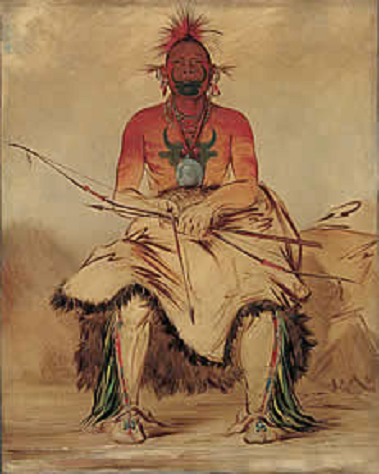
Manifest Destiny and the Art of Kean, Catlin, Miller,
Leutze,
Deas and Bodmer
- Robert Hughes, American Visions (1996), “Wilderness and the West”,
pp. 175-190 (YouTube 2:42) (YouTube 9:30) (YouTube 0:00)
- William H. Goetzmann and William N. Goetzmann,
The West of the
Imagination (1986), Chapter 2, "George Catlin: Saving the
Memory of a Vanishing Race"; Chapter 3, "The
Vogue for Galleries and Compendia: Stanley, Kane and
Eastman"; Chapter 4, "European Science and the
Noble Savage", pp. 15-57
- Textualizing the Native Americans (UVA)
-
George
Catlin;
George
Catlin's Indian Gallery;
Catlin
Paintings in the National Gallery of Art
-
Karl
Bodmer;
Images
from Prince Maximilian's Travels in the Interior of
North America.
-
The
Illustrating Traveler: Adventure and
Illustration in North America and the Caribbean,
1760-1895
-
The American West (Spartacus)
|
|
|
The Scalp Hunters:
|
Kit Carson and The
Mountain Men

Kit
Carson, the fighting trapper
- Henry Nash Smith, Virgin Land: The American West as Symbol and Myth
(1950) VIII.
The Mountain Man as Western Hero: Kit Carson
- William H. Goetzmann and William N. Goetzmann,
The West of the
Imagination (1986), Chapter 5, "The Mountain Men: A Fair
Likeness", pp. 58-68
- Burdett: Life of Kit Carson (1869)
- Kit Carson Dime Novel
- Jill Lepore, "Westward Ho!: Revisiting Kit Carson—the man, the myth, and the dime-novel hero" New Yorker 2006
-
The
Mountain Men (Emily Zimmerman's Project) (UVA)
-
Kit
Carson (PBS, The West)
- 3.7 Legendary scout and mountain man, Kit Carson, in his later years
-
A
Collection of Portraits of Mountain Men;
A
Collection of Mountain Man Artifacts;
Green
River Rendezvous Pageant;
Jim
Bridger's Rifle
Alfred Jacob Miller,
Trappers
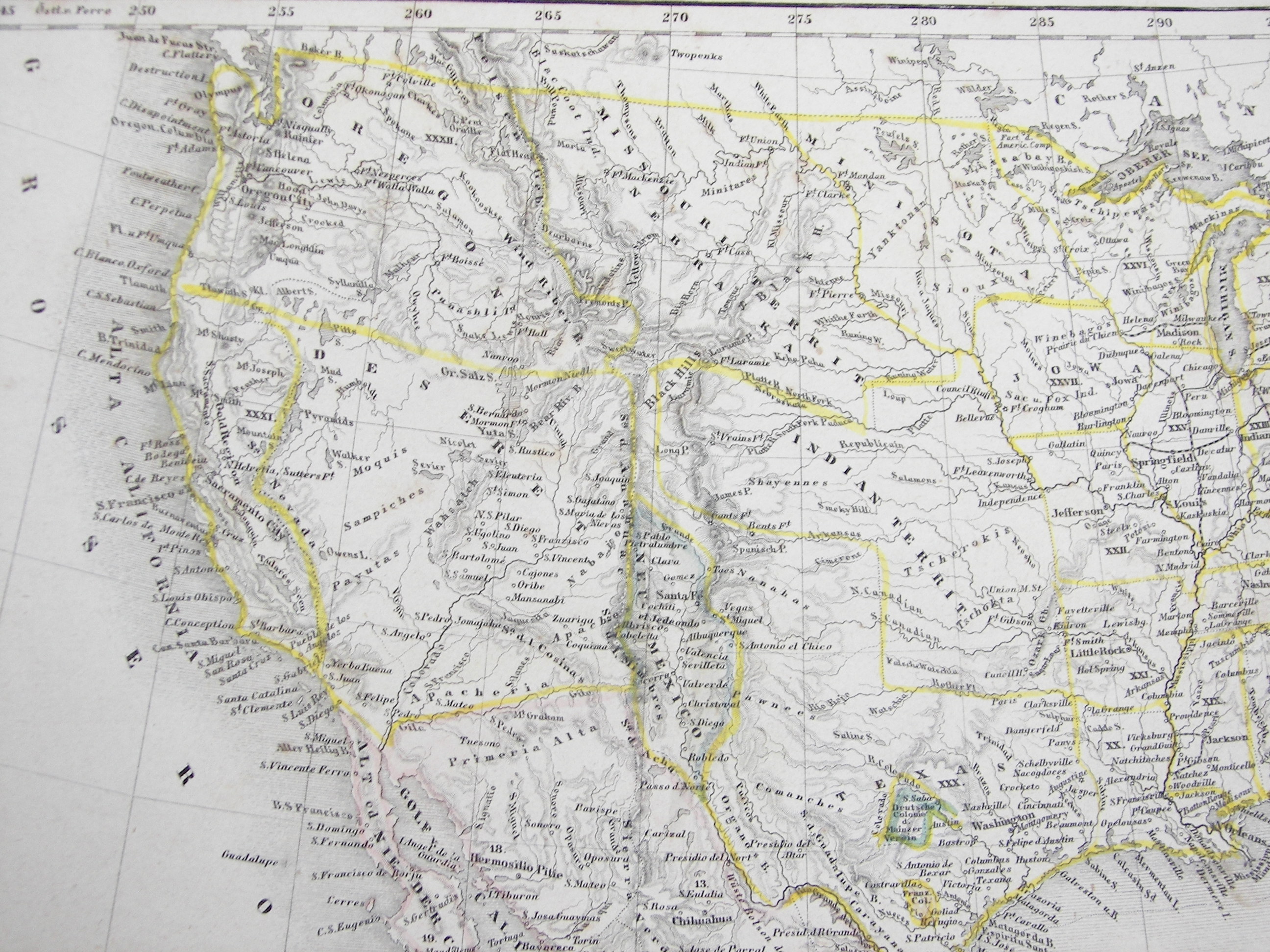
Bride - 1850 Map of the Southwest
-
Mountain Men and the
Fur Trade
-
The American West (Spartacus)
|
|
Deadwood Dick, Calamity Jane and the Birth of the Western Dime Store Hero
|
|
George Caleb Bingham and America's Big River
|
|
|
The South and the Myth of the Garden:
|
|
Women Out West & In Texts, 1861 - 1873
Some Miners and Mining-Camps: 1861 - 1873
|
|
from Roughing It (1872) by Mark Twain
| | Other Accounts: | |
"The Big Trees and Yo Semite": 1860 - 1873
|
|
Frontispiece from At Home and Abroad
By Bayard Taylor (1862) | | before 1851: Valley lived in by Yosemite portion of Miwok tribe, who call it Ahwahnee
1851: "Discovery" of Valley by non-native Americans, a cavalry troop led by Major
James Savage, pursuing a party of Yosemites -- they rename the valley Yo-Semite
1852: "Discovery" of the Big Trees of Calaveras by A. T. Dowd,
a hunter employed by the Union Water Company
1855: J. M. Hutchings, collecting material for a California Magazine article,
leads first party of sight-seers into Valley
1856: First house built in Valley, a hotel for tourists
1864: To preserve the Valley and "Big Trees," Congress gives California
48.6 square miles for a state park
1890: Yosemite National Park established | | | | |
West Meets East: Depicting the Chinese, 1860 - 1873
 From Roughing It, Chapter 54 From Roughing It, Chapter 54
|
1850: California imposes Foreign Miner's License Tax
1852: 11,794 Chinese live in California (only 7 are women)
1854: California Supreme Court upholds ban against testimony from Chinese witnesses
1860s: Over 30,000 Chinese enter the U.S; nearly all are men who work as laborers
1871: Anti-Chinese riots in Los Angeles, part of larger pattern of violence
1882: Exclusion Act prohibits Chinese laborers from entering U.S. | |
|
|
|
African-Americans in the American West
|
|
Slave Narratives from the Old South
|
|
Photography and Virgin Land
|
|
|
John James Audubon and the Birds of America:
Reflections of the American Romantic Sensibility
|
|
|
|
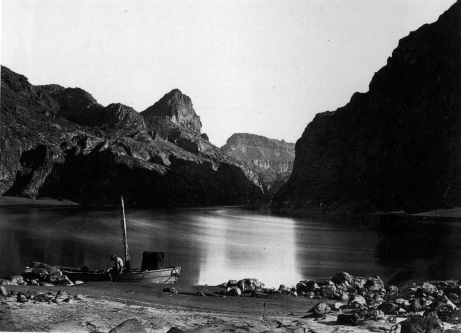
Thomas Moran and William H. Jackson: Exploring Yellowstone
and the Grand Canyon
-
Joshua
John's Project (UVA)
-
Thomas
Moran (National Gallery of Art);
Thomas
Moran at the National Gallery of Art (May); Go West, Moran, October 1997, Smithsonian Magazine;
American
Visionaries: Thomas Moran (National Park);
William H.
Jackson, Photographer (BBHS)
-
American
Memory: The Evolution of the Conservation Movement,
1850-1920
-
American
Memory: Mapping the National Parks
-
The
Photographer, The Artist and Yellowstone Park (LOC)
- Robert Hughes, American Visions (1996), “Wilderness and the West”,
pp. 198-202 (YouTube)
- William H. Goetzmann and William N. Goetzmann,
The West of the
Imagination (1986), Chpater 15, "Artist and Photographer
in Wonderland", pp. 170-182; "The Grandest Canyon of Them
All", pp. 183-190
-
The American West (Spartacus)
|
|
|
The Last of the Buffalo: Sacred Nature: Albert Bierstadt vs. The Lakota Sioux
and The Ghost Dance Movement
- Robert Hughes, American Visions (1996), “Wilderness and the West”
pp. 194-198, 201-203 (YouTube 2:33) (YouTube :35)
- William H. Goetzmann and William N. Goetzmann, The West of the
Imagination (1986), Chapter 13, "Bierstadt's Mighty
Mountains", pp.145-157; Chapter 14, "The Wonders of
Yosemite", pp. 158-169
-
Albert
Bierstadt Online;
Matthew
Baigell on Bierstadt
-
Darwin’s Impact:
Social
Evolution in America, 1880–1920 ;
Herbert Spencer: Social Darwinism
-
The American West (Spartacus)
- Webb: Buffalo Land (1872)
- Kicking Bear's 1890 speech to a Council Meeting of the. Hunkpapa)
- The Buffalo Harvest, by Frank Mayer with Charles B. Roth -- the life and times of a "buffalo runner" in the 1870's.
- Mrs. Z. A. Parker, the Ghost Dance at Pine Ridge Reservation (1890) -- an eyewitness account.
- Wovoka, The Messiah Letter (1891) -- the message that sparked the Ghost Dance movement.
- James McLaughlin, An Account of Sitting Bull's Death (1891) -- by the Indian Agent who ordered the arrest.
- Pvt. W. H. Prather, "The Indian Ghost Dance and War" (1890) -- a barracks ballad by a member of the Ninth Cavalry.
- Lakota accounts of the massacre at Wounded Knee (1891) -- the survivors speak.
- General Nelson A. Miles, report on the "Sioux Outbreak of 1890" and selected field dispatches (1891) -- a commander's view of the last Indian uprising.
- Ghostdance (Website)
- Ghostdance (Clip from Into the West (2005))
- The Ghostdance
Movement (Michigan State);
Imaging and
Imagining the Ghost Dance: James Mooney's Illustrations and Photographs,
1891-1893 (Indiana U.);
The
Buffalo Harvest, by Frank Mayer with Charles B. Roth
-- the life and times of a "buffalo runner" in
the 1870's. (photos) ;
Mrs.
Z. A. Parker, the Ghost Dance at Pine Ridge Reservation
(1890) -- an eyewitness account.;
Wovoka,
The Messiah Letter (1891) -- the message that sparked
the Ghost Dance movement.;
Pvt.
W. H. Prather, "The Indian Ghost Dance and War"
(1890) -- a barracks ballad by a member of the Ninth
Cavalry.
- Theodore Roosevelt, Ranch Life and the Hunting Trail (1888) -- memoirs of his years as a Dakota rancher.
|
|
|
|
Buffalo Bill’s Wild West Show:
The Closing of the Frontier and the Birth of Pop Culture
- Robert Hughes, American Visions (1996), “Wilderness and the West”
- William H. Goetzmann and William N. Goetzmann, The West of the
Imagination (1986), Chapter 23, "The American Scout
Triumphant", pp. 287-297
- Buffalo Bill (1869-1872)
- Webb: Buffalo Land (1872)
- William F. Cody, Life and Adventures of "Buffalo Bill," (1917) -- the final edition of an evolving autobiography.
-
Buffalo Bill's Wild West Show (UVA);
Buffalo
Bill
(UVA)
- Buffalo
Bill (The West)
-
William
F. Cody, Life and Adventures of "Buffalo
Bill," (1917) -- the final edition of an
evolving autobiography. (photos)
-
Frederick Jackson Turner
Thesis
-
The American West (Spartacus)
- Richard White, "Frederick Jackson Turner and Buffalo Bill," in The Frontier in American Culture (1994)
- Louis Warren, “Cody’s Last Stand: Masculine Anxiety, the Custer Myth, and the Frontier of Domesticity in Buffalo Bill’s Wild West,” Western Historical Quarterly, Vol. XXXIV, No.1 (Spring 2003)
- Ned Buntline, Buffalo Bill and His Adventures in the West (1886). Read pp 1-43.
- Photographs:
|
|
|
Frederic Remington’s Wild West:
Social Darwinism and Nostalgia for the Mythic West
- Robert Hughes, American Visions (1996), “Wilderness and the West”,
pp. 203-205 (YouTube 3:00)
- Goetzmann, The West of the
Imagination (1986), Chapter 18, "Episodes of Glory";
Chapter 19, "Views of a Tragedy" (Little Bighorn); pp.
206-227; Chapter 21, "Frederic Remington: No Teacup Tragedy",
pp. 237-257
-
Frederic
Remington (American Masters);
Frederic Remington Art
Museum ;
Frederic
Remington Online (Artcyclopedia) ;
Frederic
Remington (NGA); Remington Looking West (Clark Art Institute)
-
Darwin’s Impact:
Social
Evolution in America, 1880–1920;
Herbert Spencer: Social Darwinism
-
Frederick Jackson Turner
Thesis
-
The American West (Spartacus)
- Richard White, "The Winning of the West: The Expansion of the Western Sioux in the Eighteenth and Nineteenth Centuries,” Journal of American History 65.2 (1998)
- effrey Ostler, “Conquest and the State: Why the United States Employed Massive Military Force to Suppress the Lakota Ghost Dance,” Pacific Historical Review 65.2 (1996)
- Paul Rosier, "Indian Country in the Twenty-First Century," in Serving Their Country: American Indian Politics and Patriotism in the Twentieth Century (2009)
- Elizabeth Custer, Boots and Saddles (1899). Read the last chapter (XXIX).
- Aaron Beede, Sitting Bull - Custer (1913)
|
The Silent Western: Early Hollywood’s Myth of the West
-
Mary
Halnon's Project (UVA)
- William H. Goetzmann and William N. Goetzmann,
The West of the
Imagination (1986), Chapter 24, "Cowboys and Cameramen",
pp. 298-310
- Frederick Jackson Turner Thesis
-
The American West (Spartacus)
- Phil Deloria, "Representation," in Indians in Unexpected Places (2004)
- Watch: John Ford's Fort Apache (1948)
- Early films:
|
|
|