|
Chaucer’s
General Prologue to The Canterbury Tales
European Humanities
Fall 2018
Chaucer’s
Pilgrims and The Late Medieval World (c. 1397)
Here is the
essay question:
How does
Chaucer’s portrait of English society at the end of the 14th century
reveal changes for good and evil overtaking Medieval Europe as it
enters the Renaissance?
Group One:
The
Knight, The
Squier, and The Yeoman
Group Two:
The
Prioresse, The Monk, and The
Friar
Group Three:
The
Merchant, The
Clerk, The Sergeant at Law,
The Franklin, The
Shipman, The
Doctor of Physik, The Wife of
Bath,
Group Four:
The
Parson and The Ploughman
Group Five:
The
Miller, The
Maunciple, The
Reeve, The
Summoner, The
Pardoner
Amor v. Amor
Dei
Chaucer
describes the impregnation of March by April’s sweet showers and the
subsequent birth of virtue.
He inverts
traditional Church teaching about the nature of Earthly Love and Divine
Love. Augustine’s formulation of Original Sin had deemed the earthly
realm to be corrupt and utterly separate from the transcendent City of
God.
Chaucer
suggests that God’s heaven can be found on Earth: in Love. The most
perfect expression of God’s love may be in earthly happiness,
particularly the passionate love between man and woman best expressed
in Holy Matrimony. Chaucer’s God is immanent. Chaucer’s God gives us
permission to enjoy life and to revel in our humanity.
However,
Chaucer is not
suggesting that all human behavior inspired by Spring is Holy. Rather,
the impulse itself is holy- although it can be perverted by man.
So
our task in reading The Canterbury Tales is to use our
own
critical imagination to play God: we must determine which of the
pilgrims will make it into heaven and which will not. And our job is
not made easy by Chaucer: he has upset the dogmatic judgments of the
Church; instead, we must use our own imagination and determine if the
pilgrim is misusing the gifts God has given them or is he or she being
true to oneself and thus natural and holy.
Group One:
The Nobility

The Knight
A KNYGHT ther was, and that a worthy man,
That fro the tyme that he first bigan 45 To riden out, he loved chivalrie, Trouthe and honour, fredom and curteisie. Ful worthy was he in his lordes werre,
And therto hadde he riden, no man ferre,
As wel in cristendom as in hethenesse, 50
And evere honoured for his worthynesse.
At Alisaundre he was, whan it was wonne. Ful ofte tyme he hadde the bord bigonne
Aboven alle nacions in Pruce;
In Lettow hadde he reysed, and in Ruce, 55
No Cristen man so ofte of his degree.
In Gernade at the seege eek hadde he be
Of Algezir, and riden in Belmarye.
At Lyeys was he and at Satalye,
Whan they were wonne; and in the Grete See 60 At many a noble armee hadde he be.
At mortal batailles hadde he been fiftene,
And foughten for oure feith at Tramyssene
In lystes thries, and ay slayn his foo.
This ilke worthy knyght hadde been also 65
Somtyme with the lord of Palatye
Agayn another hethen in Turkye.
And everemoore he hadde a sovereyn prys;
And though that he were worthy, he was wys,
And of his port as meeke as is a mayde. 70 He nevere yet no vileynye ne sayde
In al his lyf unto no maner wight.
He was a verray, parfit gentil knyght.
But, for to tellen yow of his array,
His hors were goode, but he was nat gay. 75 Of fustian he wered a gypon
Al bismotered with his habergeoun,
For he was late ycome from his viage,
And wente for to doon his pilgrymage. |
The Knight
How has
Chaucer brought this idealized portrait of a type to full life?
Is Chaucer
sad that the Knight's days are drawing to a close, or might he be
secretly happy?
‘he loved
chivalrie, trouthe, honour, fredom and courtesie’ (l.45)
"He was a
verray, parfit gentil knyght." (l.72)
A Crusader:
The Knight
is an exceptional warrior: a killer who has trained in fighting in
armor, with horses, lances, swords and shields. He has fought in
fifteen ‘mortal battailles’, an extraordinary number, against infidels
(ie Islam) on the Northern, Southern and Eastern borders of
Christendom. He has been at Alexandria, Prussia, Lithuania and in
Russia, in Grenada at the siege of Algeciras, in Morocco at Ayash and
at Atalia, and in the Grete Sea, and at Tlemcen against the heathen
in Turkey.
The
Crusades: Wars to hold back the Islamic hordes, and hopefully, to
spread Christianity… but also to maintain peace at home by sending
armed threats overseas.
The Knight has been
in ‘lystes thries’: formal duels in which champions of opposing armies
fight to the death in lieu of a full scale battle.
This Knight
is a superman!
Humility:
‘no
vileynye ne sayde/ in al his
lyf unto no maner wight.’(70)
He treats
all members of society with respect, even those from classes beneath
his own. “Villain”: fighting words during the Renaissance.
Chaucer's
special touch: The Knight's Costume: his horses are of high quality,
but he wears a ‘bismotered habergeoun’: a spotted, grimy, possibly even
bloody coat of mail- indicating that he has only lately returned from
his most recent battles. He has gone
immediately on pilgrimage after battle to
give thanks for the preservation of his life and to purge his sins. He cares more for his
horses than he does for
his appearance.
Code of
Chivalry:
The Church
needed a defender of the Faith. They wanted to justify the war so they
created a chivalric code: an ideal that justifies violence against the
infidel: prowess at arms, courage, honesty.
loyalty,
generosity, faith, courtesy.
The Knight
subscribes to a moral, religious and social code of conduct which
emphasized duty to country, to God, and to the service of a lady. The
story he tells his fellow pilgrims is about two best friends who both
fall in love with the same lady (who is married).
Courtly
Love:
Unrequited
Love Sublimated into Violence. In feudal society, wealth was based on
land, and land was primarily transferred through marriage. Therefore,
most upper class marriages were arranged. They were not based on love.
The Cult of Courtly Love glorified love OUTSIDE of marriage as more
virtuous than a married relationship without love. Is Chaucer really
celebrating Courtly Love?
Ironically,
the code of chivalry developed from Arab origins!
Medieval Spain was the "cradle of chivalry", for the
European fostering of chivalric tradition began in al-Andalus.
(Wikipedia)
Chaucer’s
Knight exemplifies the ideals of chivalry, but he does so in a
realistic way. He is no knight in shining armor but a real, living
breathing person with the qualities of humility, faith, and courage
that make him fit to be a king, the leader of Medieval society.
vs. Sir
Galahad's Grail Quest, Sir Lancelot's love for Queen Guinevere , or Sir
Tristan's love for Iseult
Problems:
To what
degree does the Knight help hold in place a social system which is
fundamentally unjust? The idealization of his character may not conform
to the real social practice which held 97% of the population in
serfdom, condemned to short, impoverished existences.

The Squier
With hym ther was his sone, a yong SQUIER, 80 A lovyere and a lusty bacheler;
With lokkes crulle, as they were leyd in presse.
Of twenty yeer of age he was, I gesse.
Of his stature he was of evene lengthe,
And wonderly delyvere, and of greet strengthe. 85
And he hadde been somtyme in chyvachie
In Flaundres, in Artoys, and Pycardie,
And born hym weel, as of so litel space,
In hope to stonden in his lady grace. Embrouded was he, as it were a meede, 90
Al ful of fresshe floures, whyte and reede; Syngynge he was, or floytynge, al the day,
He was as fressh as is the monthe of May.
Short was his gowne, with sleves longe and wyde.
Wel koude he sitte on hors, and faire ryde. 95 He koude songes make, and wel endite,
Juste, and eek daunce, and weel purtreye and write.
So hoote he lovede, that by nyghtertale
He slepte namoore than dooth a nyghtyngale.
Curteis he was, lowely, and servysable, 100
And carf biforn his fader at the table. |
The Squier:
How did the chivalric tradition transform the conception of Romantic
Love? How has Chaucer taken the stereotype of the medieval troubadour
and brought him to full life?
‘a lovyere
and lusty bacheler’ (80)
A Troubadour Bachelor:
troubadour:
One of a
class of lyric poets, wandering minstrels and jongleurs, who lived from the 11th to the
13th centuries and helped invent the notion of romantic love.
bachelor:
A bachelor
in Chaucer’s time referred to not only an unmarried man, but a young
man who has worked his way up to the first degree of knighthood… To
move up this ladder, he must do grace to a lady faire by distinguishing
himself in battle. He has ‘born hym weel’ in a calvalry expedition
against the French in Flanders (100 Years War) ‘in hope to stonden in
his lady grace’ The
Squier's Costume:
an expensive
embroidered tunic; his hair is worn in ‘lokkes crulle’. He is the
height of fashion, youth and gaiety. He is a singer, a poet, a dancer
and a troubadour. He loves to play the flute, and he is irresistable to
the ladies!
So hoote he
lovede, that by nyghtertale
He slepte namoore than dooth a nyghtyngale.
Curteis he was, lowely, and servysable,
And carf biforn his fader at the table. (l. 97-100)
The most
perfect expression of God’s Love is the love between a man and a woman
in marriage. This Squire goes off at night to sing for his girl. He
loves her passionately. He hopes that his songs, his poetry, his looks,
his dress and his tales of valor in France will win her to be his wife.
Marriage for
LOVE, not MONEY or LAND
His desire
for love could easily be corrupted into an appetite for sensual
gratification. Chaucer's Special Touch is that the Squier honors his
father by carving before him at the table. Does this detail indicate to
you that the Squier has enough respect for doing the right thing that
he will fulfill Chaucer's model of the lover in a healthy way?
The
Trouvères and the Troubadours
Popular
music, usually in the form of secular songs, existed during the Middle
Ages. This music was not bound by the traditions of the Church, nor was
it even written down for the first time until sometime after the tenth
century. The
subject of the overwhelming majority of these songs is love, in all its
permutations of joy and pain. One of the most famous of these trouvères
known to us (the great bulk of these melodies are by the ubiquitous
"Anonymous") is Adam de la Halle (ca. 1237-ca. 1286). Adam is the
composer of one of the oldest secular music theater pieces known in the
West, Jeu de Robin et de Marion (1284)
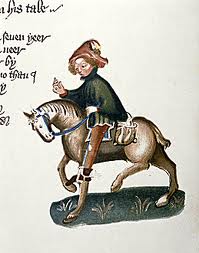
The Yeoman
A YEMAN hadde he and servantz namo
At that tyme, for hym liste ride soo;
And he was clad in cote and hood of grene.
A sheef of pecok arwes, bright and kene 105 Under his belt he bar ful thriftily,
(Wel koude he dresse his takel yemanly:
Hise arwes drouped noght with fetheres lowe)
And in his hand he baar a myghty bowe. A not heed hadde he, with a broun visage, 110 Of woodecraft wel koude he al the usage.
Upon his arm he baar a gay bracer,
And by his syde a swerd and a bokeler,
And on that oother syde a gay daggere Harneised wel and sharpe as point of spere. 115
A Cristopher on his brest of silver sheene.
An horn he bar, the bawdryk was of grene; A forster was he, soothly, as I gesse. |
The Yeoman
'A
Cristopher on his brest of silver sheene.’ (115)
Traveling by
road during the Middle Ages was dangerous. Highwaymen and thieves
waylaid unprotected travelers, so a party of armed men accompanied most
nobles. The Knight travels with only one servant: no ostentatious show,
just what is necessary. And he has no reason to fear: he has a killing
machine at his side.
The knight's
sidekick is a yeoman, a free born servant, not a serf tied to the land.
The yeoman is armed to the teeth: he carries a longbow, a sheaf of
arrows, a sword and buckler, and a dagger and horn.
The 100
Years War
This yeoman has
fought beside the Knight in all his battles, and he shares in the
Knight's glory. He carries the English longbow, a weapon which changed
the strategy of warfare during the 100 Year War. (A series of wars
between England and France fought over claims to French territory by
the descendants of William the Conqueror. The famous Battle of Crécy
was a complete disaster for the French, largely due to English
longbowmen. A vastly superior French force had trapped the English army
against the sea, but the strategy they used to attack was outmoded. In
medieval wars, the knights in armor would fight each other with lances
on horseback and then hand to hand.with swords. The French nobles
leading the charge at Crecy were repelled by English
longbowmen firing arrows over long distances with bows like the
one the Yeoman carries. These arrows were capapble of penetrating
the knight's armor and killing their horses. The French forces were decimated by this new weapon, and after the battle of Crecy, the
warfare at which Chaucer's Knight excelled ended forever, replaced
by contending armies of commoners armed with the Yeoman's longbow and
supported by cavalry charges.
Stories told
about the great heroes of the fighting in the 100 Year War became
legend for both the English and the French. The exploits of the Black
Prince and later of Henry V served later leaders who used their
popularity as a foundation for English nationalism. The French as well
turned the story of Joan of Arc into a founding myth of their own nation state.
This yeoman,
though, may be weary of battle, yearning to return to his life as a
forester and hunter: he wears a St. Christopher medal, which protects
travelers from sudden death. The detail humanizes Chaucer's portrait of
this killing machine. Here is a soldier who longs for home, the woods,
where his talents can be put to their best use, as a hunter and
craftsman.
Group Two:
The Clergy

The Prioresse
Ther was also a Nonne, a PRIORESSE, That of hir smylyng was ful symple and coy; 120 Hir gretteste ooth was but by Seinte Loy;
And she was cleped Madame Eglentyne. Ful weel she soong the service dyvyne, Entuned in hir nose ful semely,
And Frenssh she spak ful faire and fetisly, 125
After the scole of Stratford-atte-Bowe,
For Frenssh of Parys was to hir unknowe.
At mete wel ytaught was she with alle:
She leet no morsel from hir lippes falle,
Ne wette hir fyngres in hir sauce depe; 130 Wel koude she carie a morsel, and wel kepe
That no drope ne fille upon hir brist.
In curteisie was set ful muche hir list.
Hire over-lippe wyped she so clene
That in hir coppe ther was no ferthyng sene 135 Of grece, whan she dronken hadde hir draughte. Ful semely after hir mete she raughte.
And sikerly, she was of greet desport,
And ful plesaunt, and amyable of port,
And peyned hir to countrefete cheere 140 Of court, and been estatlich of manere,
And to ben holden digne of reverence.
But, for to speken of hir conscience,
She was so charitable and so pitous
She wolde wepe, if that she saugh a mous 145 Kaught in a trappe, if it were deed or bledde.
Of smale houndes hadde she, that she fedde
With rosted flessh, or milk and wastel-breed.
But soore weep she if oon of hem were deed,
Or if men smoot it with a yerde smerte; 150 And al was conscience, and tendre herte. Ful semyly hir wympul pynched was,
Hire nose tretys, hir eyen greye as glas,
Hir mouth ful smal, and therto softe and reed;
But sikerly she hadde a fair forheed; 155 It was almoost a spanne brood, I trowe;
For, hardily, she was nat undergrowe. Ful fetys was hir cloke, as I was war;
Of smal coral aboute hir arm she bar
A peire of bedes, gauded al with grene, 160
An theron heng a brooch of gold ful sheene,
On which ther was first write a crowned A,
And after Amor vincit omnia. |
The
Prioresse:
‘a
prioresse/that of her smylyng was ful symple and coy’ (l.118-19)
‘[M]adam
Eglentye’ is the head of a priory, a nunnery attached to an abbey of the
Benedictine order. Her responsibility is to help arrange the choral
music for the nunnery’s divine services (which she does so ‘entuned in her nose ful
semely’). These services punctuate the day from early morning until nightfall. She
must also preside at the priory’s meals, maintaining order and the
priory’s sacred decorum.
Yet Chaucer
focuses upon the Prioresse's physical beauty, her refined manners and sophisticated
sensibility: characteristics of of her upper class status. Her name, Eglentyne,
is
borrowed from the realm of romance stories popular at the time.
Chaucer's narrator describes her a face with ‘nose tretys. Her 'eyen
greye as glas,/ her mouth ful smal, and
thereto soft and redde/ But sikerly she hadde a fair foreheed'
(152-54) This face was the model of beauty in Chaucer’s society (and a
nun’s forehead was never supposed to be visible beneath her habit!)
She travels
with her pets: a brood of ‘smale houndes’ that ‘she fedde/ With rosted flessh, or milk and
wastel-breed.’ (Her dogs are better fed than most peasants would have
been!) Eglentyne is fluent in the French learned in Stratford, England (which is
very classy but her French would have been incomprehensible in Paris!)
She is very aristocratic and sophisticated. This style probably would
have grated against the English commoner, and Chaucer is writing a poem
celebrating a patriotic national identity!
Her
table
manners are impeccable! Chaucer's Narrator spends ten lines describing
the way she eats! (He is clearly smitten! Not a crumb falls from her
lip, she doesn’t wet
her fingers in gravy, doesn’t slobber, or reach across the table-- she
makes every effort
to use good ‘curtesie’. Compared with the typical table manners of a
medieval man, her style is remarkable! (Remember that this was a time
before the fork had become a standard utensil. People ate with their
hands.)
Eglentyne possesses a delicately refined conscience: ‘she wolde wepe, if that she
saugh a mous/ Kaught in a trappe’ (144-45) What form of conscience
should we expect from a nun who has devoted her life to a sacred
purpose?
Her Costume:
her nun’s habit is ‘ful fetys’, very elegant; The perfect touch: she wears a bejewelled,
coral string of rosary beads from which hangs a gold brooch engraved
with the letter ‘A’ and the maxim, “Love conquers all.” Who gave that to her? Such jewelry is
hardly appropriate to a nun and is certainly a decoration that would
have been out of dress code! As a matter of fact, what is she doing on this trip!
Yet the
narrator is obviously charmed by Eglentyne's whole manner. She is
indeed made for love. What has Chaucer done to our stock expectations
of the leader of a nunnery in the midst of a holy era? What is
Eglentyne's great talent? Will she realize it in a nunnery? Can you
infer the type of reforms that Chaucer would like to see in the
medieval church?

The Monk
A MONK ther was, a fair for the maistrie,
An outridere, that lovede venerie,
A manly man, to been an abbot able.
Ful many a deyntee hors hadde he in stable,
And whan he rood, men myghte his brydel heere 170 Gynglen in a whistlynge wynd als cleere
And eek as loude, as dooth the chapel belle.
Ther as this lord was keper of the celle,
The reule of Seint Maure, or of Seint Beneit,
By cause that it was old and somdel streit 175 This ilke Monk leet olde thynges pace,
And heeld after the newe world the space.
He yaf nat of that text a pulled hen,
That seith that hunters beth nat hooly men,
Ne that a monk, whan he is recchelees, 180
Is likned til a fissh that is waterlees,-
This is to seyn, a monk out of his cloystre
But thilke text heeld he nat worth an oystre;
And I seyde his opinioun was good.
What sholde he studie, and make hymselven wood, 185
Upon a book in cloystre alwey to poure,
Or swynken with his handes and laboure,
As Austyn bit? How shal the world be served?
Lat Austyn have his swynk to him reserved!
Therfore he was a prikasour aright: 190 Grehoundes he hadde, as swift as fowel in flight;
Of prikyng and of huntyng for the hare
Was al his lust, for no cost wolde he spare.
I seigh his sleves purfiled at the hond
With grys, and that the fyneste of a lond; 195
And, for to festne his hood under his chyn,
He hadde of gold ywroght a curious pyn;
A love-knotte in the gretter ende ther was.
His heed was balled, that shoon as any glas,
And eek his face, as it hadde been enoynt. 200
He was a lord ful fat and in good poynt,
Hise eyen stepe, and rollynge in his heed,
That stemed as a forneys of a leed;
His bootes souple, his hors in greet estaat.
Now certeinly he was a fair prelaat; 205 He was nat pale as a forpyned goost.
A fat swan loved he best of any roost.
His palfrey was as broun as is a berye, |
The Monk:
‘a
manly man… an outridere
that loved venerie’ (166)
The Monk is
another senior cleric with the Benedictine order, but he clearly does
not follow type. Instead of withdrawing from the busy world into a
monastery where he should be living a quiet life of prayer, study, and
manual labor, this monk embraces the world and revels in its pleasures!
He’s a big
enough man to be an abbot! He owns many horses and rides with a bridle 'Gynglen in a whistlynge wynd als cleere And eek as loude, as dooth the chapel belle.' .So you can hear him coming from a mile away!
How religious is the Monk? He has let the
old habits pass and ‘heeld after the newe world the space’ (176): a
very modern monk indeed! He thinks little of the monastic rules laid
out a thousand years before by St. Augustine. ‘He yaf not of that text
a pulled hen.’ (177) ‘Let Austyn have his swynk to him reserved!’ (188)
The Monk and Love: He instead spends most of his time hunting the 'hare' (double entendre?) Instead this
monk is a ‘prikasour aright’: a hunter of hares He
spares no price to own a pack of the best greyhounds.
Primogeniture: One reason
why people like this Monk wound up in the clerical estate was because
of the law of primogeniture. To keep the land and property of noble
families together, the oldest son would inherit everything. Younger
sons were offered lucrative positions in the church to placate them. So
high church positions, such as the one this rich monk possesses,
frequently went to people who had little interest in the church’s
religious mission.
His Costume: The Monk’s
cloak is hardly the appropriate garb for a devout Benedictine monk. It
is finely sewn: his sleeves are trimmed with grey squirrel fur, and his
hood is fastened with a gold pin shaped like a ‘love-knotte’! Who gave him that gift? His bald
head shines as if ‘enoynt’ with holy oil (it is really perspiration!)
He wears supple leather boots and rides a beautiful berry colored horse. He must have cut a dashing
figure!
Chaucer’s
final touch? The monk loves to eat roasted swan-- hardly the typical
fare of an ascetic who should deny himself the pleasures of the flesh!
What is Chaucer doing to our typical notions of this holy stereotype?
What vision of the medieval world in 1380 is emerging?
What is this
Monk's great talent? How can he realize it?

The Friar
A FRERE ther was, a wantowne and a merye, A lymytour, a ful solempne man. 210
In alle the ordres foure is noon that kan
So muchel of daliaunce and fair langage.
He hadde maad ful many a mariage
Of yonge wommen at his owene cost.
Unto his ordre he was a noble post, 215
And wel biloved and famulier was he
With frankeleyns overal in his contree,
And eek with worthy wommen of the toun;
For he hadde power of confessioun,
As seyde hymself, moore than a curat, 220 For of his ordre he was licenciat. Ful swetely herde he confessioun,
And plesaunt was his absolucioun:
He was an esy man to yeve penaunce,
Ther as he wiste to have a good pitaunce. 225 For unto a povre ordre for to yive
Is signe that a man is wel yshryve;
For, if he yaf, he dorste make avaunt,
He wiste that a man was repentaunt;
For many a man so harde is of his herte, 230 He may nat wepe, al thogh hym soore smerte;
Therfore in stede of wepynge and preyeres
Men moote yeve silver to the povre freres.
His typet was ay farsed ful of knyves
And pynnes, for to yeven yonge wyves. 235 And certeinly he hadde a murye note:
Wel koude he synge, and pleyen on a rote;
Of yeddynges he baar outrely the pris.
His nekke whit was as the flour-de-lys;
Therto he strong was as a champioun. 240 He knew the tavernes wel in every toun
And everich hostiler and tappestere
Bet than a lazar or a beggestere;
For unto swich a worthy man as he
Acorded nat, as by his facultee, 245 To have with sike lazars aqueyntaunce.
It is nat honeste, it may nat avaunce,
For to deelen with no swich poraille,
But al with riche and selleres of vitaille.
And over al, ther as profit sholde arise, 250 Curteis he was, and lowely of servyse.
Ther nas no man nowher so vertuous.
He was the beste beggere in his hous;
(And yaf a certeyn ferme for the graunt
Noon of his brethren cam ther in his haunt;) 255 For thogh a wydwe hadde noght a sho,
So plesaunt was his "In principio"
Yet wolde he have a ferthyng, er he wente;
His purchas was wel bettre than his rente.
And rage he koude, as it were right a whelp. 260
In love-dayes ther koude he muchel help,
For there he was nat lyk a cloysterer
With a thredbare cope, as is a povre scoler,
But he was lyk a maister or a pope;
Of double worstede was his semycope, 265
That rounded as a belle out of the presse.
Somwhat he lipsed for his wantownesse
To make his Englissh sweete upon his tonge;
And in his harpyng, whan that he hadde songe,
Hise eyen twynkled in his heed aryght 270
As doon the sterres in the frosty nyght.
This worthy lymytour was cleped Huberd |
The Friar:
‘a
lymytour, a ful solempne man…
So muchel of daliaunce and fair langage’ (211)
The Franciscan Order: The Friar
is, supposedly, a member of the Franciscan order, missionaries who have
taken a vow of poverty and chosen to live humbly, begging money in the
streets to aid the poorest of the poor. Friars imitate the life of St.
Francis of Assisi,
a 12th century Italian nobleman who gave up all his
wealth to serve lepers and ease the suffering of the homeless. He is
one of the most venerated saints in Christian history. The one rule of
the Order was “To follow the teachings of our Lord Jesus Christ and to
walk in his footsteps.” St. Francis took that to mean living a life of
complete humility: wearing a simple grey habit, embracing poverty, and
begging for money to fund services for the poorest of the poor. The Franciscan Order in London called themselves the Greyfriars
and the church they established in the shambles of the meatpacking
district eventually had become by Chaucer's time a leading
religious and philanthropic organization. raising money for hospitals
and schools. Christ's Hospital was founded by the Franciscans, and
eventually evolved into one of Gilman's partner schools in England!
Chaucer's Friar could hardly be more different from St. Francis. He is a South London street hustler!
This guy is one sweet talker, an expert at ‘daliaunce and fair
langage’. Under his expert influence, he has arranged the ‘marriages’
of many of the impoverished girls living in his begging district for his
friends and aquaintances. Frequently, the Friar's customers are franklins: free born commoners who have become wealthy landowners and fequent visitors to London.
It sounds
good, but the fact of the matter is that The Friar is a pimp, and he uses
the power of the confessional booth to befriend homeless women in his
district… and he gives each and everyone an easy absolution for the sins they commit, particularly those who are ‘penitent’.
What is this rogue’s scam? ‘in
stedye of wepynge and preyeres/ Men moote yeve silver to the povre
freres.’ (231-32) Hard cash earns repentance as well as tears! And the
girls? What must they give in return? His cloak is
stuffed with knives and pins which he peddles on the street to ‘faire
wyves’. He knows the bartenders and waitresses in his district better
than he knows the lepers and beggars. (According to him it would not be
right to be seen with such riff-raff!) He’d rather spend his time partying with
rich merchants, victuallers, and tourists. He also loves to sing songs at the bar! Don't under estimate him though. The Friar is a good fighter who holds on to
his begging territory aggressively! This is one talented beggar! He can even get a
farthing out of a shoeless widow!
What does
the Franciscan order think of this behavior? Chaucer's narrator emphasizes twice that they will look away as long as the Friar keeps raising so much money. ‘Unto his ordre he was a
noble post.’ (214) (a bit of Chaucerian bawdry?) ‘He was
the beste beggar in his hous’ (251) Don't ask; don't tell. The
Franciscan elders of the late 14th c. are happy as long as they receive their cut of his
profits.
'Love-Days': Chaucer's
Friar is also a great expert on ‘love-days’, those special legal
holidays when poor
disputants without the money to afford an attorney can resolve
financial suits in impromptu street courts. (ala Judge Judy) There he
holds forth like the pope!
The Friar's Costume::
a double woven cloak, round as a bell from the mold of his belly; The Friar
purposely lisps when he talks, to sweeten his speech, and his eyes twinkle
like stars! His name is “Huberd”!
Wow! How
does Chaucer portray these representatives of the organized Church?
What has happened to the franciscan order? What is this guy's talent? How could it be used properly?
Group Three: The Middle Class

The Merchant
Chaucer's Merchant Family: Feudal
social theory had no room for non-military laymen who were neither
manual laborers nor skilled tradesmen. However, merchants were
increasingly visible, asserting a powerful influence on the London
economy. Bankers alone had enough money to finance the king’s ambitious
foreign wars. Chaucer’s father had been a wine merchant who made a
fortune selling foreign vintages to the upper class. Chaucer himself
was employed as the comptroller of customs in 1370, responsible for regulating
trade and collecting excise taxes on wool, furs and hides. (A highly lucrative position!) Usury: The merchant
in Chaucer’s day was often satirized for his secrecy in business deals
and for his dubious financial dealings. The Catholic Church regarded
usury as blasphemous. (Usury is the lending of capital at an interest.
As we discovered in the 2008 financial meltdown, without credit our
whole economy came to a standstill.)
The Merchant's Costume: He wears motley (the fool's
garb at court), a fashionable, very expensive beaver fur hat, and good
boots. The narrator can not tell us much about this man because the merchant
doesn’t have much to say. When he does speak, he only refers to matters
pertaining to business: ‘th’encrees of his wynning’, the safety of the
seas between England and Holland, the current value of currency, and
his upstanding reputation as a businessman free from debt. Can you put
together the various hints Chaucer gives us and explain why this
merchant has gone on a pilgrimage at this particular moment?
The narrator thinks back, and come to think of it, no one remembers his name! Why
not?
How does Chaucer portray the emerging merchant class in England at the end
of the 14th century? Can you draw conclusions about his moral judgment
of capitalism? 
The Clerk
A CLERK ther was of Oxenford also,
That unto logyk hadde longe ygo.
As leene was his hors as is a rake, 290 And he nas nat right fat, I undertake,
But looked holwe and therto sobrely.
Ful thredbare was his overeste courtepy;
For he hadde geten hym yet no benefice,
Ne was so worldly for to have office. 295 For hym was levere have at his beddes heed
Twenty bookes, clad in blak or reed,
Of Aristotle and his philosophie,
Than robes riche, or fithele, or gay sautrie.
But al be that he was a philosophre, 300
Yet hadde he but litel gold in cofre;
But al that he myghte of his freendes hente,
On bookes and on lernynge he it spente,
And bisily gan for the soules preye
Of hem that yaf hym wherwith to scoleye. 305
Of studie took he moost cure and moost heede.
Noght o word spak he moore than was neede,
And that was seyd in forme and reverence,
And short and quyk, and ful of hy sentence;
Sownynge in moral vertu was his speche, 310
And gladly wolde he lerne, and gladly teche. |
The Clerk:
'ful
thredbare was his overeste courtepy’
The Clerk is
a college student at Oxford, reading for religious orders: the Trivium
(grammar, logic and rhetoric) and the Quadrivium (arithmetic, geometry,
astronomy, and music.) Oxford University is now the oldest college in the English speaking world and remains one of Europe's most distinguished universities. Humanism: In
Chaucer's day Oxford had become a center of Humanism, an emerging
intellectual movement which would play a huge role in re-introducing
classical learning to Europe during the Renaissance. Humanism stressed
the dignity of humanity and shifted intellectual
emphasis from theology and logic to the study of human wisdom. The clerk's curricuulm included the 'studia humanitatis':
educational disciplines outside of theology and natural science.
Students had to master both Latin and Greek to acquire a thorough
grounding in the works of Cicero, Plato, and Aristotle. (Cicero was
considered the model citizen: eloquent, wise and committed to the
service of the state. All students carefully studied his speeches and
imitated his style.)
Humanism was opposed to the particular brand of logic known as
Scholasticism, whose intent was to reconcile the revealed truth of
Christianity with Greek reason.
The Clerks' Dilemma: The Clerk has not yet been granted his
benefice: the ecclesiastical position that will enable him to earn a
living ala the Monk or the Friar. He has not yet taken his vows of
chastity. However, he’d really rather study Aristotle than read the Bible. He wants
to become a teacher, not a priest: his twenty books are more valuable
to him than rich robes, music or a ‘psalterie’ (An ancient and medieval
stringed instrument, more or less resembling the dulcimer).
The Clerk is a
philosopher, but he cannot earn any money at such a profession. He only
prays for the souls of those who contribute to his education. The Clerk
speaks no more than necessary and when he does, his speech is ‘short
and quyk and full of hy sentence’. He loves learning and wants to
teach, but the teaching profession had not yet sepated itself from the church.
The Clerk's Costume: Devoted to
his studies, the Clerk rides a lean horse and wears a threadbare cape.
He looks ‘holwe’ to the narrator.
What vision
of the changing place of education and classical learning is suggested
by Chaucer’s depiction of the Clerk? Why isn’t there a job for him in
this society? What
kind of priest would he make?

The Sergeant of Law
A SERGEANT OF THE LAWE, war and wys,
That often hadde been at the Parvys,
Ther was also, ful riche of excellence.
Discreet he was, and of greet reverence- 315
He semed swich, hise wordes weren so wise. Justice he was ful often in assise,
By patente, and by pleyn commissioun.
For his science, and for his heigh renoun,
Of fees and robes hadde he many oon. 320 So greet a purchasour was nowher noon:
Al was fee symple to hym in effect,
His purchasyng myghte nat been infect.
Nowher so bisy a man as he ther nas,
And yet he semed bisier than he was. 325
In termes hadde he caas and doomes alle
That from the tyme of Kyng William were falle.
Therto he koude endite and make a thyng,
Ther koude no wight pynche at his writyng;
And every statut koude he pleyn by rote. 330 He rood but hoomly in a medlee cote Girt with a ceint of silk, with barres smale;
Of his array telle I no lenger tale. |
Sergeant of
Law
‘Nowher so
bisy a man as he there was,/
And yet he semed bisier than he was.”
The Legal System in Chaucer's Time: A lawyer for
the crown, the Sergeant at Law possesses the highest legal rank in
society. In this position, he serves as a circuit judge and barrister
on the porches of St. Paul’s Cathedral, the location of the king’s
legal court. As justice at the court of assizes, he would issue patents
with the full authority of the crown. He is therefore in a position to
rake in a lot of bribes on top of his percentage of the fees assessed
on business dealing.
Common Law
had become the highest authority in England after King John was forced
to sign the Magna Charta in 1215. He acknowledged that even a King was
not above the law. Feudal Law: Prior to the establishment of this legal tradition,
nobles ruled arbitrarily in the criminal cases and
business disputes that came before them. In those days trial by
jury did not exist. Citizens could request a trial by ordeal to appeal
the decision of a noble, but most people elected not to, as this sort of
trial involved holding a smoking hot iron bar with your bare hands or
being dunked in a pond for minutes at a time! The rise of English
Common Law ranks as one of the most important social achievements in
our history because judges and juries had to be bound by the legal
precedents established over time. In this way a fairer legal process
could be guaranteed any citizen…. As long as the system avoided
corruption.
Chaucer’s
Seargeant of Law exercises the full power of the crown. His word has
become law. No one can say anything about his judgments…because he
knows inside out all the legal precedents and statutes established
since the time of William the Conqueror. He seems busier than he really
is. Why?
The Seargeant at Law's Costume: This guy is
rich but he is not ostentatious. He wears simple cloth of dyed wool,
(but it is lined with silk!)
What point
is Chaucer making about the law and the legal profession of his time?

The Franklin
A FRANKELEYN was in his compaignye.
Whit was his berd as is a dayesye; 335 Of his complexioun he was sangwyn.
Wel loved he by the morwe a sope in wyn,;
To lyven in delit was evere his wone,
For he was Epicurus owene sone,
That heeld opinioun that pleyn delit 340 Was verray felicitee parfit.
An housholdere, and that a greet, was he; Seint Julian was he in his contree.
His breed, his ale, was alweys after oon,
A bettre envyned man was nowher noon. 345
Withoute bake mete was nevere his hous
Of fissh and flessh, and that so plentevous,
It snewed in his hous of mete and drynke,
Of alle deyntees that men koude thynke.
After the sondry sesons of the yeer, 350 So chaunged he his mete and his soper.
Ful many a fat partrich hadde he in muwe,
And many a breem and many a luce in stuwe.
Wo was his cook, but if his sauce were Poynaunt and sharp, and redy al his geere. 355 His table dormant in his halle alway
Stood redy covered al the longe day.
At sessiouns ther was he lord and sire; Ful ofte tyme he was knyght of the shire.
An anlaas and a gipser al of silk 360 Heeng at his girdel, whit as morne milk. A shirreve hadde he been, and a countour.
Was nowher swich a worthy vavasour. |
The Franklin
‘Wel loved
he by the morwe a sop in wyn’
Traveling
with the Sergeant of Lawe is his good friend the Franklin. A franklin
was a free born provincial land holder, yet he was born as a
commoner. He is a provincial country squire, but he is friendly with
this wealthy and influential nobleman. Chaucer’s point?
Chaucer
describes the Franklin as of ‘sangwyn complexioun’. According to the
medieval medical theory of the humours, a sanguine temperament is
caused by the suffusion of blood in the body. Psychologically, a
sanguine man possesses great optimism and good humor. Chaucer depicts
the Franklin as ruddy of face, of good digestion and as ‘Epicurus’ owne
sone’. An Epicurean lives for nothing but pleasure. (Bring on wine,
women and song, for tomorrow we die!) This franklin lives for pleasure,
particularly in food. Like St Julian, he is a great patron of
hospitality. At his dinners, ‘it snewed of mete and drinke’. In his
house he always keeps the traditional hospitality table (from which all
visitors can help themselves) full of roast birds, meat and fish.
The Franklin's Political Career: The Franklin
serves as the district judge ‘at sessiouns’ in his neighborhood. He has
also been elected the ‘knight of the shire’ or member of Parliament for
his region. Since the days of the Magna Carta, English kings had been
forced to rely upon the compliance of a council of nobles
whenever they wanted to
raise taxes. During the reign of Edward I in the century prior to
Chaucer’s birth, Parliament had begun admitting elected representatives
from citizens around the country. These electors exercised considerable
influence over land policy.
How did
Chaucer’s Franklin become so rich?
The Franklin's Costume: He
wears a dagger and carries a silk purse ('gipser')--
just like a nobleman.
What point
is Chaucer making about the changing composition of medieval society?
How is society also becoming more secular in its focus?

The Shipman
A SHIPMAN was ther, wonynge fer by weste;
For aught I woot, he was of Dertemouthe.
He rood upon a rouncy, as he kouthe,
In a gowne of faldyng to the knee.
A daggere hangynge on a laas hadde he 395
Aboute his nekke, under his arm adoun.
The hoote somer hadde maad his hewe al broun,
And certeinly he was a good felawe.
Ful many a draughte of wyn had he ydrawe
Fro Burdeux-ward, whil that the chapman sleep. 400 Of nyce conscience took he no keep.
If that he faught, and hadde the hyer hond,
By water he sente hem hoom to every lond.
But of his craft, to rekene wel his tydes,
His stremes, and his daungers hym bisides, 405 His herberwe and his moone, his lodemenage,
Ther nas noon swich from Hulle to Cartage.
Hardy he was, and wys to undertake;
With many a tempest hadde his berd been shake.
He knew alle the havenes as they were, 410
From Gootlond to the Cape of Fynystere,
And every cryke in Britaigne and in Spayne.
His barge ycleped was the Maudelayne. |

The Doctor of Physik
With us ther was a DOCTOUR OF PHISIK;
In al this world ne was ther noon hym lik, 415
To speke of phisik and of surgerye,
For he was grounded in astronomye.
He kepte his pacient a ful greet deel
In houres, by his magyk natureel.
Wel koude he fortunen the ascendent 420 Of his ymages for his pacient.
He knew the cause of everich maladye,
Were it of hoot, or coold, or moyste, or drye,
And where they engendred, and of what humour.
He was a verray parfit praktisour: 425
The cause yknowe, and of his harm the roote, Anon he yaf the sike man his boote.
Ful redy hadde he hise apothecaries
To sende him drogges and his letuaries,
For ech of hem made oother for to wynne- 430
Hir frendshipe nas nat newe to bigynne.
Wel knew he the olde Esculapius,
And Deyscorides and eek Rufus,
Olde Ypocras, Haly, and Galyen,
Serapioun, Razis, and Avycen, 435
Averrois, Damascien, and Constantyn,
Bernard, and Gatesden, and Gilbertyn.
Of his diete mesurable was he,
For it was of no superfluitee,
But of greet norissyng, and digestible. 440
His studie was but litel on the Bible.
In sangwyn and in pers he clad was al,
Lyned with taffata and with sendal;
And yet he was but esy of dispence;
He kepte that he wan in pestilence. 445 For gold in phisik is a cordial,
Therfore he lovede gold in special. |

The Wife of
Bath
A good WIF was ther, OF biside BATHE,
But she was somdel deef, and that was scathe.
Of clooth-makyng she hadde swich an haunt, 450
She passed hem of Ypres and of Gaunt.
In al the parisshe wif ne was ther noon
That to the offrynge bifore hire sholde goon;
And if ther dide, certeyn so wrooth was she,
That she was out of alle charitee. 455 Hir coverchiefs ful fyne weren of ground;
I dorste swere they weyeden ten pound
That on a Sonday weren upon hir heed.
Hir hosen weren of fyn scarlet reed,
Ful streite yteyd, and shoes ful moyste and newe. 460 Boold was hir face, and fair, and reed of hewe.
She was a worthy womman al hir lyve:
Housbondes at chirche dore she hadde fyve,
Withouthen oother compaignye in youthe, -
But therof nedeth nat to speke as nowthe. 465
And thries hadde she been at Jerusalem;
She hadde passed many a straunge strem;
At Rome she hadde been, and at Boloigne,
In Galice at Seint-Jame, and at Coloigne.
She koude muchel of wandrynge by the weye. 470 Gat-tothed was she, soothly for to seye.
Upon an amblere esily she sat,
Ywympled wel, and on hir heed an hat
As brood as is a bokeler or a targe;
A foot-mantel aboute hir hipes large, 475
And on hir feet a paire of spores sharpe.
In felaweshipe wel koude she laughe and carpe.
Of remedies of love she knew per chaunce,
For she koude of that art the olde daunce. |
The Wife of
Bath
“She was a
worthy womman al hir lyve:/
Housbandes at chirche she hadde fyve.”
The Town of Bath: This
merry
widow comes from Bath, a town founded by the Romans to take advantage
of the hot springs in the area. By Chaucer's time Bath was renowned
throughout England as a center for the
production of finely woven fabrics. On the Wife's head she displays
delicately
woven cloth (covering a metal rig that must weigh ten pounds!) She is a
walking advertisement for her weaving business and her widowhood (which
may be one and the same). The Wife of Bath is filthy rich! At church on
Sundays she is furious if someone else deigns to approach the
offertory before she does!
Church Marriage Law: Chaucer mentions that she has had five
husbands at church. (That doesn’t count the ‘oother compaignye’ she had
in her youth.) St. Paul had taught that the sacrament of marriage bound husband and wife together for eternity. The Wife of Bath's Prologue is one of the great sections of The Canterbury Tales! In it the Wife defends her right to remarry no matter what St. Paul might
have said! She holds forth about her relationships with her several
husbands and how she taught them to respect her and enjoy life!
World Traveller: “She koulde
muchel of wandyrnyge by the weighe.” She has been
to Jerusalem three times! (A journey of several months in Chaucer’s
day!) She’s been on many pilgrimages to shrines in Rome, Bologna,
Cologne, and even Saint James at Compastella (in Spain), the most
famous shrine in Christendom outside Jerusalem. This list is fabulous,
possibly unbelievable! She may be stretching the truth a bit. How many of these pilgrimages has she made out of holy
devotion to God
How has the
Wife of Bath built such a highly lucrative living? Where does she meet
her prospective husbands? ‘Gat-tothed was she, soothly for to sey.’ What did medieval
superstition say about gap-toothed women? She loves
to laugh and talk and have fun, (and she knows many remedies for
venereal diseases!) Very
funny! The Wife of Bath with all of her bawdy, good humor and love of
life has also become a completely independent woman. She may just be
Chaucer's vision of a religious ideal, certainly the first liberated
woman in the history of English literature. Why is she on this pilgrimage? The Wife's Costume: Beneath her
fine mourning garments, she wears fine scarlet stockings! She has a
bold red face and reddish hair. She wears a huge hat, a huge
overskirt, and on her supple boots she wears ‘sharpe spurs’!
What is
Chaucer’s purpose in his depiction of the Wife of Bath? How does this
outrageous, larger than life character seem to jump off the page and
into our lives directly from the Middle Ages? What is the measure of
Chaucer’s genius as an artist?
Group Four:
The Foundation of the Medieval Order
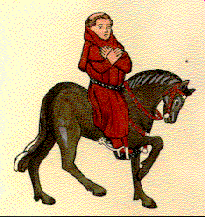
The Parson
A good man was ther of religioun, 480 And was a povre PERSOUN OF A TOUN,
But riche he was of hooly thoght and werk.
He was also a lerned man, a clerk,
That Cristes gospel trewely wolde preche;
His parisshens devoutly wolde he teche. 485 Benynge he was, and wonder diligent,
And in adversitee ful pacient,
And swich he was ypreved ofte sithes.
Ful looth were hym to cursen for his tithes,
But rather wolde he yeven, out of doute, 490 Unto his povre parisshens aboute
Of his offryng and eek of his substaunce.
He koude in litel thyng have suffisaunce.
Wyd was his parisshe, and houses fer asonder,
But he ne lefte nat, for reyn ne thonder, 495 In siknesse nor in meschief to visite
The ferreste in his parisshe, muche and lite,
Upon his feet, and in his hand a staf.
This noble ensample to his sheep he yaf,
That first he wroghte, and afterward he taughte. 500
Out of the gosple he tho wordes caughte,
And this figure he added eek therto,
That if gold ruste, what shal iren do?
For if a preest be foul, on whom we truste,
No wonder is a lewed man to ruste; 505
And shame it is, if a prest take keep, A shiten shepherde and a clene sheep.
Wel oghte a preest ensample for to yive,
By his clennesse, how that his sheep sholde lyve.
He sette nat his benefice to hyre 510 And leet his sheep encombred in the myre
And ran to Londoun unto Seinte Poules
To seken hym a chaunterie for soules,
Or with a bretherhed to been witholde;
But dwelt at hoom, and kepte wel his folde, 515 So that the wolf ne made it nat myscarie;
He was a shepherde and noght a mercenarie.
And though he hooly were and vertuous,
He was to synful men nat despitous,
Ne of his speche daungerous ne digne, 520 But in his techyng discreet and benygne;
To drawen folk to hevene by fairnesse,
By good ensample, this was his bisynesse.
But it were any persone obstinat,
What so he were, of heigh or lough estat, 525 Hym wolde he snybben sharply for the nonys.
A bettre preest I trowe, that nowher noon ys.
He waited after no pompe and reverence,
Ne maked him a spiced conscience,
But Cristes loore, and Hise apostles twelve 530
He taughte, but first he folwed it hymselve. |
The Parson
‘But
Christes loore and his apostles twelve/ He taughte; but first he folwed
it hymselfe.’
Before we
conclude that Chaucer’s vision of his age is completely cynical, let us
consider his portraits of the village parson and his brother, the plowman. These
idealized portraits epitomize the principles of church and society that
had held civilization together for a millennium.
An Idealized Village Parson Chaucer’s Parson is a poor village priest: learned, happy with few possessions
and patient in adversity. He is loath to punish his parishioners for
not paying their tithes to the Church, as is required. Instead he will give
what little he has to them! He doesn’t neglect his people despite the
wide size of his parish, despite rain, sickness or the mischief of the
road.
He carries a
staff, like a good shepherd, and catches his sheep with the good words
of the gospel. He regards his example as essential to the well being of
his parishioners. What can they believe in if their priest be foul?
The Business of Benefice He does not
rent out his benefice, as many parish priests do, or leave his flock to run to St. Paul’s in
London where he can use his license to collect funds from rich patrons if he pomises to pray for their
souls. He does not join a wealthy
guild in town and earn a fee praying for them. Instead he remains a
shepherd, not a mercenary.
He treats
the sinful with compassion, not contempt. He draws his country folk to heaven by
fairness and his good example, but if a sinner is not penitent, he will
shun him as wicked even if he comes from high estate.
In
short, he
strives to follow Christ’s laws as best he can and teach his flock the
pathway to a better life in heaven. For what purpose is he
taking his pilgrimage to Canterbury? But why does Chaucer place this wonderful parson so low on the social hierarchy?
The Ploughman
With hym ther was a PLOWMAN, was his brother,
That hadde ylad of dong ful many a fother;
A trewe swynkere and a good was he,
Lyvynge in pees and parfit charitee. 535
God loved he best with al his hoole herte
At alle tymes, thogh him gamed or smerte,
And thanne his neighebor right as hym-selve.
He wolde thresshe, and therto dyke and delve,
For Cristes sake, for every povre wight 540 Withouten hire, if it lay in his myght.
Hise tithes payed he ful faire and wel,
Bothe of his propre swynk and his catel.
In a tabard he rood, upon a mere. |
The Ploughman
‘God loved
he best with al his hoole herte’
Travelling
with the Parson is his brother, the Plowman, another idealized portrait
of a social type that preserved the stability of the medieval hierarchy
for centuries.
The Plowman
is a freeman, not a bonded laborer like the serfs, but he is a willing servant. He
accepts his humble place in society and recognizes that to work hard is to
serve God. He threshes the crops, digs the ditches, and builds the dykes
that preserve us from the flood. He asks for no profit for his labor.
He accepts instead the meager allowance which feeds and houses him. He
pays his tithe not just on his produce but on the full value of his
cattle.
Were these
portraits of the Parson and the Plowman nostalgic glances back at a
world fast receding into the past, or were they emblematic of the ideal
world towards which the pilgrims need to rededicate themselves? What is
Chaucer’s purpose? The Great Plague of 1348-50
The social
situation in Chaucer’s time had been transformed by the virulence of
the Black Plague which struck most terribly in the years 1348-50
killing nearly a third of the population and recurred throughout the
century. The resulting huge population decline devastated the labor supply and,
ironically, gave peasants the political weapon they needed to demand
reforms to the feudal economic system. Historian Lee Patterson
described the situation:
The plague
shifted the balance of power dramatically and hastened the end of
feudalism as a social and economic system. Before the plague land and
food were scarce while labor was abundant and demand was voracious;
after the plague the situation was exactly the opposite: there was lots
of land, far fewer mouths to feed with a now plentiful agricultural
crop, and a severe shortage of labor. (Patterson) (See The
Great Plague of 1348-50)
Wat Tyler’s Peasant Revolt (1381) Parliament
sought to maintain the status quo in a series of statutes which
restricted the rights of peasants to work for the highest bidder and
led eventually to a peasant uprising in 1381 which thoroughly terrified
the ruling class. (See Wat
Tyler’s Peasant Revolt 1381)

The Miller
The MILLERE was a stout carl for the nones; Ful byg he was of brawn and eek of bones-
That proved wel, for over al ther he cam 550 At wrastlynge he wolde have alwey the ram.
He was short-sholdred, brood, a thikke knarre,
Ther was no dore that he nolde heve of harre,
Or breke it at a rennyng with his heed.
His berd as any sowe or fox was reed, 555
And therto brood, as though it were a spade.
Upon the cop right of his nose he hade
A werte, and thereon stood a toft of herys,
Reed as the brustles of a sowes erys;
Hise nosethirles blake were and wyde. 560 A swerd and bokeler bar he by his syde.
His mouth as greet was as a greet forneys.
He was a janglere and a goliardeys,
And that was moost of synne and harlotries.
Wel koude he stelen corn, and tollen thries; 565 And yet he hadde a thombe of gold, pardee.
A whit cote and a blew hood wered he.
A baggepipe wel koude he blowe and sowne,
And therwithal he broghte us out of towne. |
|
|
The Miller
‘He was a
jaglere and a goliardyeys/ Wel koude he stelen corn and tollen thries’
The Miller
is a bully, brute and thief; he is like an animal, but he is also
powerful-- like his watermill.
The Profit Principle: Millers
performed essential occupation in village communities. They not only
ground the corn and wheat into flour for bread, but they doled out the
grain according to the market price using a scale. Millers were
disliked for their dishonesty and thievery: manipulating prices to
cheat farmers and tampering with scales to take inordinate profits from
hungry people who depended on them to provide the
most basic item in their diet: the flour ground from grain. Particularly during times of famine
(frequent during the Middle Ages), the Miller was hated and feared
because he dispensed life and death through his willingness to sell or
give
grain to starving people. (See St. Albans Rising) (Millstone) (Millstone in Pavement) (The Miller's Tale) and (The Mystery Plays) (The Bleak Conclusion of the Hundred Years War)
The Miller's Physical Description: This Miller
is ‘ful byg of brawn and eek of bones’; he always wins the prize ram in
the local wrestling tournament. No door can hold him: he’ll use his
knot head to ‘breke it at a rennyng with his heed’.
On his nose
is a huge wart with a ‘toft of heyrs/ Reed as the brustles of a sowes
erys’.
The narrator
calls the Miller a thief, mentioning that he has a ‘thombe of gold’.
His mouth is
like 'a greet forneys' from which comes obscene stories and ribald
jokes. He pipes the
company of pilgrims out of Southwark, playing a march tune on his
bagpipes. (See Dooms and the Mouth of Hell in Late Medieval Period.)
What is Chaucer saying about the Profit Principle?
A gentil MAUNCIPLE was ther of a temple, 570 Of which achatours myghte take exemple
For to be wise in byynge of vitaille;
For wheither that he payde or took by taille, Algate he wayted so in his achaat
That he was ay biforn, and in good staat. 575 Now is nat that of God a ful fair grace,
That swich a lewed mannes wit shal pace
The wisdom of an heep of lerned men?
Of maistres hadde he mo than thries ten,
That weren of lawe expert and curious, 580 Of whiche ther weren a duszeyne in that hous
Worthy to been stywardes of rente and lond
Of any lord that is in Engelond,
To maken hym lyve by his propre good,
In honour dettelees (but if he were wood), 585
Or lyve as scarsly as hym list desire,
And able for to helpen al a shire
In any caas that myghte falle or happe-
And yet this Manciple sette hir aller cappe. |
|
|

The Reeve
The REVE was a sclendre colerik man. 590
His berd was shave as ny as ever he kan;
His heer was by his erys ful round yshorn;
His top was dokked lyk a preest biforn. Ful longe were his legges, and ful lene, Ylyk a staf, ther was no calf ysene. 595 Wel koude he kepe a gerner and a bynne;
Ther was noon auditour koude on him wynne.
Wel wiste he by the droghte and by the reyn,
The yeldynge of his seed and of his greyn.
His lordes sheep, his neet, his dayerye, 600
His swyn, his hors, his stoor, and his pultrye,
Was hoolly in this Reves governynge,
And by his covenant yaf the rekenynge, Syn that his lord was twenty yeer of age,
Ther koude no man brynge hym in arrerage. 605 Ther nas baillif, ne hierde, nor oother hyne,
That he ne knew his sleighte and his covyne;
They were adrad of hym as of the deeth.
His wonyng was ful faire upon an heeth;
With grene trees shadwed was his place. 610 He koude bettre than his lord purchace.
Ful riche he was astored pryvely:
His lord wel koude he plesen subtilly,
To yeve and lene hym of his owene good,
And have a thank, and yet a cote and hood. 615
In youthe he hadde lerned a good myster;
He was a wel good wrighte, a carpenter.
This Reve sat upon a ful good stot,
That was al pomely grey, and highte Scot.
A long surcote of pers upon he hade, 620 And by his syde he baar a rusty blade.
Of Northfolk was this Reve, of which I telle,
Bisyde a toun men clepen Baldeswelle.
Tukked he was as is a frere aboute,
And evere he rood the hyndreste of oure route. |
The
Reeve
‘a
slender, coleryk man’…
‘They were
adrad of hym as of the deeth./
His wonyng was ful faire upoin an heeth.’
The Reeve
is the general manager on his estate, responsible for the land and its
crops, the stock animals, the working of the farm, and the accounting
of its funds. He is crafty and sly, dominated by the humour of bile: an
angry, choleric, frightening man!
He wears a
thin close-cropped beard, short cut hair, and he has long, thin
calf-less legs. Despite his power and wealth, he seems pinched and
sickly.
He knows
every detail of the functioning of his farm: he knows the exact
contents of the granary and corn bin; no auditor can cheat him; as a
matter of fact, no one on the farm dares to cheat him. He knows all the
tricks of the trade (and is certain to have run into a fair number of
cheating millers in his time.) He knows farming so well that simply
from gauging the rain or drought, he can tell to the pound the yield of
a particular piece of land.
This Reeve
is taking advantage of a common legal loophole to reap in added gains.
The owner of his farm is not yet of legal age and therefore cannot be
sued for arrears of bills. The reeve is secretly taking advantage of
this situation by racking up as much debt as possible on the farm and
siphoning the proceeds to his own use. He gives and lends his lord’s
property. His house on the farm is larger than the owner’s!
He even
has a fall back profession if he ever gets fired! He is a skilled
carpenter.
He wears
his coat like a friar; his hair is cut like a friar, but this reeve
clearly has dedicated his life to a different religion than
Christianity.
Why do you
think he takes the ‘hyndereste’ place on the route?
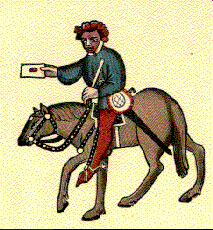
The Summoner
A SOMONOUR was ther with us in that place,
That hadde a fyr-reed cherubynnes face,
For saucefleem he was, with eyen narwe.
As hoot he was and lecherous as a sparwe,
With scalled browes blake, and piled berd, 630 Of his visage children were aferd.
Ther nas quyk-silver, lytarge, ne brymstoon,
Boras, ceruce, ne oille of tartre noon,
Ne oynement, that wolde clense and byte,
That hym myghte helpen of his whelkes white, 635 Nor of the knobbes sittynge on his chekes.
Wel loved he garleek, oynons, and eek lekes,
And for to drynken strong wyn, reed as blood;
Thanne wolde he speke and crie as he were wood.
And whan that he wel dronken hadde the wyn, 640
Than wolde he speke no word but Latyn.
A fewe termes hadde he, two or thre,
That he had lerned out of som decree-
No wonder is, he herde it al the day,
And eek ye knowen wel how that a jay 645
Kan clepen "Watte" as wel as kan the pope.
But whoso koude in oother thyng hym grope,
Thanne hadde he spent al his philosophie; Ay "Questio quid iuris" wolde he crie.
He was a gentil harlot and a kynde; 650
A bettre felawe sholde men noght fynde;
He wolde suffre, for a quart of wyn,
A good felawe to have his concubyn
A twelf-monthe, and excuse hym atte fulle;
Ful prively a fynch eek koude he pulle. 655 And if he foond owher a good felawe,
He wolde techen him to have noon awe,
In swich caas, of the ercedekenes curs,
But if a mannes soule were in his purs;
For in his purs he sholde ypunysshed be. 660
"Purs is the erchedekenes helle," seyde he.
But wel I woot he lyed right in dede;
Of cursyng oghte ech gilty man him drede,
For curs wol slee, right as assoillyng savith,
And also war him of a Significavit. 665
In daunger hadde he at his owene gise
The yonge girles of the diocise,
And knew hir conseil, and was al hir reed.
A gerland hadde he set upon his heed
As greet as it were for an ale-stake; 670 A bokeleer hadde he maad him of a cake. |
The
Summoner:
Wel loved
he garleek, oynons and eke lekes,/
And for to drynken strong wyn, reed as blood/…/And whan that he wel
dronken hadde the wyn,/ Than wolde he speke no word but Latyne.”
A summoner
is a minor, non-clerical officer of the archdeacon’s ecclesiastical
court. There were many different types of court in the middle ages. The
king exercised his power through a legal system which regulated
business and criminal behavior, but the church itself had a court which
prosecuted moral crimes: violations of the ten commandments. The church
could not sentence a person to jail or force him to pay a fine, but the
church could excommunicate a sinner, and that action would not only
condemn the person to damnation, but it would also force the community
to ostracize the sinner.
The
summoner serves as the beadle or policeman for this morals court. This
position offers him ample opportunity to practice extortion and
exercise his depravity in the community.
He is not
only morally unattractive; he is physically repugnant: ‘a fyr-reed cherubynnes face…
with scalled browes blake and piled berd...’ On his cheek are ‘whelkes
white’ and ‘knobbes’ which no ointment can heal. He loves to eat
garlic, onions and leeks and drink strong wine. The children of the neighborhood
run from his fearful visage.
That’s all
disgusting enough, but why then is he described as possessing a
‘cherubynne’s face’? In
our imagination a cherub is one of those flying infants like Cupid who
flutter about shooting arrows of love into the hearts of the
unsuspecting on Valentine’s Day. But if you look in the Bible, the
cherubim served a different purpose altogether: In Genesis when Adam
and Eve are driven from paradise, God places cherubim at the gate with
flaming swords to prevent their return and guard the path to the Tree
of Life. In Ezekiel, cherubim are described as mythological creatures
with four wings and four faces which emerge from the north wind to
protect the path to Eden. In Solomon’s Temple cherubim protect the Ark
of the Covenenant. They accompany Jesus on the Day of Judgment. If you
recall the climactic scene in Raiders of the Lost Arc,
these cherubim possess the
power to render you unto dust quite rapidly.
What is
Chaucer’s purpose? The Summoner, as the beadle for the ecclesiastical
court,
represents the terrible power of
God on the Day of Judgment. It is he who will summon both the quick and
the dead on that fateful day so that justice can be rendered. In perverting
this fundamental aspect of God’s justice, the Summoner has brought a
terrible sentence upon himself. He is the living embodiment of the
punishment that awaits us all if we do not heed God’s laws.
When he
gets drunk, he screams in Latin like he is mad! He knows a few legal
terms from hanging around the church court, and he will toss the
language of decrees about, terrifying the people. To Chaucer’s
superstitious contemporaries, words from the actual decree of
excommunication carried the power of a magical spell, banishing all
in hearing to perdition. With such magic power at his disposal, the
Summoner can circumvent the archdeacon’s writ for a price, but woe be unto those who are in his purse
(ie. debt). The Summoner is just as liable to damn them with a
‘Significat’: the order to expel an excommunicated sinner. Even the
youngest girls of the diocese are in
danger around him because, like the Friar, he has extorted from them
their secret sins and uses this knowledge to corrupt them
all! Hell, he’ll even share one of his concubines with you for a
pitcher of blood red wine!
The
Summoner truly is damned: he is a ‘gentil harlot’. He knows how to ‘pulle a
finche’: ie he knows how to hunt down young prey in his amorous
pursuits.
Costume:
On his head he wears a huge red hat as big as the sign outside an
alehouse. He carries a buckler made of cake. This guy can control
neither his eating nor his drinking.
Why is he
on this pilgrimage?

The Pardoner
With hym ther rood a gentil PARDONER
Of Rouncivale, his freend and his compeer,
That streight was comen fro the court of Rome.
Ful loude he soong "Com hider, love, to me!" 675 This Somonour bar to hym a stif burdoun;
Was nevere trompe of half so greet a soun.
This Pardoner hadde heer as yelow as wex,
But smothe it heeng as dooth a strike of flex;
By ounces henge his lokkes that he hadde, 680
And therwith he hise shuldres overspradde;
But thynne it lay by colpons oon and oon.
But hood, for jolitee, wered he noon,
For it was trussed up in his walet.
Hym thoughte he rood al of the newe jet; 685 Dischevelee, save his cappe, he rood al bare.
Swiche glarynge eyen hadde he as an hare. A vernycle hadde he sowed upon his cappe.
His walet lay biforn hym in his lappe Bretful of pardoun come from Rome al hoot. 690 A voys he hadde as smal as hath a goot,
No berd hadde he, ne nevere sholde have;
As smothe it was as it were late shave, I trowe he were a geldyng or a mare.
But of his craft, from Berwyk into Ware, 695 Ne was ther swich another pardoner;
For in his male he hadde a pilwe-beer,
Which that he seyde was Oure Lady veyl:
He seyde he hadde a gobet of the seyl
That Seint Peter hadde, whan that he wente 700 Upon the see, til Jesu Crist hym hente.
He hadde a croys of latoun ful of stones,
And in a glas he hadde pigges bones.
But with thise relikes, whan that he fond A povre persoun dwellyng upon lond, 705 Upon a day he gat hym moore moneye
Than that the person gat in monthes tweye;
And thus, with feyned flaterye and japes,
He made the persoun and the peple his apes.
But trewely to tellen atte laste, 710 He was in chirche a noble ecclesiaste.
Wel koude he rede a lessoun or a storie,
But alderbest he song an offertorie;
For wel he wiste, whan that song was songe,
He moste preche, and wel affile his tonge 715 To wynne silver, as he ful wel koude;
Therfore he song the murierly and loude. |
|
|
The Pardoner
‘His
walet, biforn hym in his lappe,/
Bretful of pardoun comen from Rome al hoot.’
The
Summoner’s good buddy is his traveling companion, the Pardoner.
Together they are merrily singing “Come hither love to me!” as they
pass their way to Canterbury.
A pardoner
was a seller of indulgences. The church actually sold writs which
offered official absolution of punishment for sins committed by those
on earth or now in purgatory. In return for this writ, the pardoner
could impose penance in the form of prayers, a pilgrimage, or more
likely alms given directly to him. Furthermore, this pardoner carries a
pillowcase full of holy relics with him which
possess medicinal qualities: he has part of the veil of the Virgin
herself, a scrap of the sail from St. Peter’s fishing boat, even a
glass full of the bones of Jesus Christ himself (which look remarkably
like pig’s bones)! By Chaucer’s time these practicies, designed to
raise funds for church projects (like hospitals and other charities), had gotten completely out of
hand. The opportunites for graft and corruption in a credulous era were
limitless. Not only did the sick and the poor seek magic remedies for
ailments, but the wealthy figured that a good investment might reduce
the time they spent in Purgatory, the cosmic waiting house where the
saved burn away their sins before entering heaven.(Nice touch! You
cannot purchase salvation, but you can certainly reduce time spent in
Purgatory with a handsome gift to the church.) Church officials had
discovered easy ways to enrich the papacy and themselves. A hundred
years after Chaucer, the rebellion against these practices would split
the Church forever during the Reformation.
This
Pardoner works for the Hospital of St Mary of Rouncivale, located in
the village of Charing Cross between London and Westminster. He ‘streight has comen fro
the court of Rome’ or so he says in his sales pitch. He possesses a
strong bass voice, like a trumpet, which he uses to hawk his wares and
to deliver impromptu sermons.
For
‘jolitee’, he wears his long yellow hair without a hood, ‘Dischevelee’,
a bold fashion choice for this age! He has bold, staring eyes like a
hare, his chin is smooth and beardless, he speaks in a small goat’s
voice, and he wears a copy of the veil of St. Veronica on his hat. All
these details suggest an effeminate appearance despite his deep bass
singing voice. A gelding? Even in the middle ages, homosexuals were
clearly among this party of English citizens
enroute to Canterbury!
The
narrator says that this pardoner has no equal from Berwyck to Ware, or
literally across the breadth of England! He can make more money in a
day than the parson will earn in a month.
In church
he preaches beautifully (even if he is not an ordained priest). He has
a beautiful bass voice (even if he dresses like a woman). He has a
silver tongue! Even so, he might represent the most damnable behavior
among this whole company of sinners: he trades upon the faith of the
people in the mercy of God and his love for humankind.
|
Chaucer's
Apology
|
|
|
|
Now have I toold you shortly in a clause,
Th'estaat, th'array, the nombre, and eek the cause
Why that assembled was this compaignye 720 In Southwerk, at this gentil hostelrye
That highte the Tabard, faste by the Belle.
But now is tyme to yow for to telle
How that we baren us that ilke nyght,
Whan we were in that hostelrie alyght; 725 And after wol I telle of our viage
And all the remenaunt of oure pilgrimage.
But first I pray yow, of youre curteisye,
That ye n'arette it nat my vileynye,
Thogh that I pleynly speke in this mateere, 730 To telle yow hir wordes and hir cheere,
Ne thogh I speke hir wordes proprely.
For this ye knowen also wel as I,
Whoso shal telle a tale after a man,
He moot reherce as ny as evere he kan 735
Everich a word, if it be in his charge, Al speke he never so rudeliche or large,
Or ellis he moot telle his tale untrewe,
Or feyne thyng, or fynde wordes newe.
He may nat spare, al thogh he were his brother; 740 He moot as wel seye o word as another.
Crist spak hymself ful brode in hooly writ,
And, wel ye woot, no vileynye is it. Eek Plato seith, whoso kan hym rede,
The wordes moote be cosyn to the dede. 745 Also I prey yow to foryeve it me,
Al have I nat set folk in hir degree
Heere in this tale, as that they sholde stonde.
My wit is short, ye may wel understonde. |
|
|
|


