|
Voltaire
vs. Rousseau on the French Revolution: Directions: |
For your next project, you will work in groups to
prepare a presentation for class on the French Revolution. Do
a good job because you have an essay due on this topic next Thursday!
Essay Topic:
How, if they had lived, would Voltaire and Rousseau have debated the
political philosophies justifying the three different stages of the
French Revolution? How would they have responded to the thinkers
worldwide who applauded or denounced the revolution?
Resources on Voltaire and Rousseau:
To research your presentation, you will be reading
both primary and secondary sources. A. To begin, skim this overview of the
French Revolution:
B. Next you should read the overview of your
group's topic, another secondary source.
Group One: The
Liberal Revolution:
Group Two: The
Radical Revolution:
Group Three: Napoleon
and the Napoleonic Code:
Group Four: Reactions
to the French Revolution:
C. Then you and your group members should
divide up responsibilities for reading the various primary sources.
Read your document and summarize the main point that is being made by
the writer. Find good quotes to support your interpretation.
D. Next, decide what Voltaire and Rousseau
would have thought of your writer's idea.
E. Finally, get together with your partners
and decide what Voltaire and Rousseau would have said about your
general topic. Present your conclusions to the class in a PowerPoint
presentation. F. Be careful to document your sources and
to use proper MLA format in preparing your presentation. |
Group One: The Liberal Revolution:
Group Two: The Radical Revolution:
|
Overview:
The
Radical Revolution (Hooker) (2ndary) Study Guide
Outline
of the French Revolution (Powerpoint)
- The
Declaration of Pillnitz
- Counter
Revolution
- The Girondists
- The Montagnard
- The
Sans-culottes
- The
Reign of Terror
- The Levee en
Masse
The
French Revolution: The Radical Stage, 1792-1794
(2ndary) Kreis
Chartier,
Roger. The
Cultural Origins of the French Revolution.(excerpt)
(2ndary)
Documents: A Girondin View: Roland Calls on the King to Declare War (GMU)
Prudhomme’s Description of the Coup against the Girondins (31 May–2 June 1793) (GMU)
More Girondin Documents
Marat, "The King Is a Friend of the People" (29 December 1790 and 17 February 1791) (Marat Archive)
Marat, “What Men Are More Vain than the French?” (July 12, 1792) (Marat Archive)
Marat, "Louis Capet at the Bar of the Convention" (December 1792) (Marat Archive)
Marat, "The Execution of the Tyrant" (January 1793) (Marat Archive)
A contemporary account by Lebois of the murder of Jean-Paul Marat
Ca
ira ('It'll be OK) (Song of the
Sans-Culottes)
Hebert, Père
Duchesne Idealizes the Sans–culottes (1792)
The
Marseillaise and Midi
File or All
Seven Verses in French (Primary)
Condorcet, Account of the Events of August 10, 1792 The Storming of the Tuilleries
The Permanent Guillotine, revolutionary song 1792
Address of the Brave Sans-Culottes to the National Convention, November 1792.
Proclamation
of the Department of the Seine–et–Oise (9 March 1792)
(peasant on grain prices) (GMU)
Danton, To the Tribunals (1792)
What is a sans culotte? (1793)
Pere Duchesne on the life of the sans culottes (1794)
A British account of the execution of Charlotte Corday (August 1793)
Edmund Burke laments the execution of Marie-Antoinette (November 1793)
The
Leveé
en Masse, August 23,
1793
Manifesto
of the Enragés (1793) (Primary)
Couthon, “That Wretched City Must Disappear” Letter to St. Just (1793)
Saint-Just, Report On the Incarcerated (1793)
All the brigands....are finally exterminated, (1793)
Decree on the Republican Calendar
Robespierre, Defense of the Committee of Public Safety, 1793
Robespierre, Principles of Political Morality, February 1794
Robespierre, Justification of the Use of Terror, February 1794
Robespierre, On the Enemies of the Nation, May 1794
Robespierre, Festival of the Supreme Being, July 1794
Robespierre, Terror
and Virtue (excerpts);
Report
on the Principles of Political Morality (1794)
Reading
Guide
Robespierre, On
the Festival of the Supreme Being,
1794 (Primary)
Edmund Burke, The
Death of Marie Antoinette (Primary)
Condorcet, The
Future Progress of the Human Mind (1795) (Primary)
Early Socialism: from The
Doctrine of Gracchus Babeuf 1795 (UVA) (Primary)
|
Group Three: Napoleon and the Napoleonic Code
|
Overview:
Napoleon (Hooker)(2ndary) Study Guide
Outline
of the French Revolution (Powerpoint)
Europe
and the Superior Being: Napoleon (2ndary) Kreis
- The Thermidorean
Reaction
- Napoleon Bonaparte’s Rise to Power
- The Consulate (1799-1804)
- The Napoleonic Code
- The Empire
- The Hundred Days
Documents:
The
French Revolt and Empire: 1792-1815 (Secondary)
Napoleon, Speech
to Troops (1796)
Napoleon,"The 18th
Brumaire
of the Year VIII" (1799);
Napoleon, Napoleon's Proclamation to the French People on Brumaire (1799)
Napoleon, Brumaire Decree (1799)
Napoleon, Order for Suppressing the Newspapers January 17, 1800 (27 Nivôse, Year VIII)
Napoleon, Law for Re-establishing Slavery in the French Colonies May 20, 1802 (30 F1oréa1, Year X).
Napoleon, Account
of the Situation of the Empire (1804)
from the
Code
Napoleon (1804);
Napoleon, The Berlin Decree
(1806);
Napoleon, Imperial
Catechism (1806)
Napoleon, Farewell
to the Old Guard (1814)
Napoleon, The
Return of Napoleon from Elba (1815)
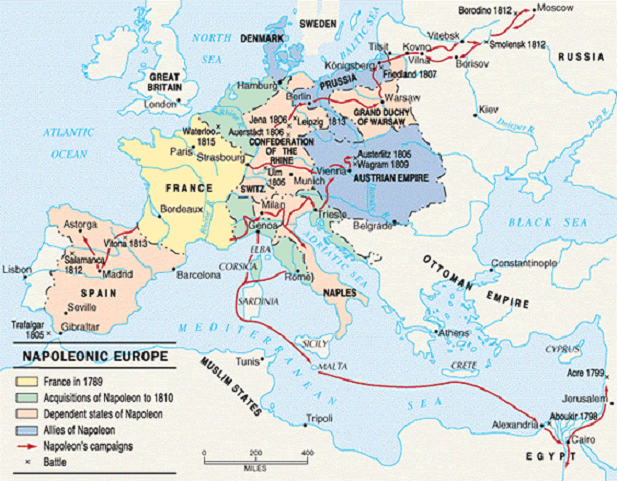
Napoleon’s Conquests (Map)
O'Malley: Wellington's
Crossing of the Douro, 1809
Tolstoy, Count Leo Nikolayevich. War and Peace. Excerpt (Primary)
|
Group Four: Reactions to the French Revolution
|
Overview:
Europe in 1815: The
Congress of Vienna; The
Congress of Vienna and the Rise of German Nationalism (ppt) (Map)
The
Congress of Vienna (Hooker)
The
Language of Politics: England and the French Revolution
(2ndary)
Outline
of the French Revolution (Powerpoint)
On Burke: "Reactionary
Prophet" Christopher Hitchens
Atlantic Monthly April
2004
Voltaire vs. Rousseau vs. Edmund Burke Women and the French Revolution (Videos)
- Revolutionary Movements Worldwide
- The Congress of Vienna
- Edmund Burke and Conservatism
- Johan Fichte and German Nationalism
Documents:
Haitian Revolutions: Crash Course World History #30 (Video)
Vincent Oge,
the Younger, A Haitian
Mulatto Claims Civil and Political Rights (Primary)
Toussaint
L'Ouverture
and the Haitian Revolution (2ndary)
The
Revolution on Santo Domingo (2ndary)
Olympe de
Gouges. Declaration
of the Rights of Woman and Citizen (Citoyenne),
1791, excerpt (Primary)
Mary Wollstonecraft, Vindication of the Rights of Women
(1792) (commentary)
(2ndary)
Europe in 1815: Reassertion of Conservatism at The
Congress of Vienna; The
Congress of Vienna and the Rise of German Nationalism (ppt) The Congress of Vienna
(Hooker)
Carlyle's
Letters on the French Revolution
Edmund Burke. Reflections
on the Revolution in France, excerpt, 1791 (Primary)
Edmund Burke (1729-1797): Reflections
on the Revolution in France, 1791, short excerpts (Primary)
Edmund Burke more short excerpts
from Reflections on the Revolution in France,
1791
Edmund Burke, The Death of Marie Antoinette (Primary)
Johann Gottlieb Fichte, Thirteenth
Address to the German Nation except (Primary)
Thomas Paine (1737-1809): Rights on Man
1792 (commentary) (2ndary)
|
|